

Tuesday, August 27, 2024
The Paris 2024 Paralympic Games are fast approaching and promise adrenaline-pumping moments with 22 sports on the clock and an avalanche of medals at stake. It's with this competitive spirit that the French government has mobilized French scientific forces with its Priority Research Program - Very High Performance Sport, which includes the Paraperf project "Optimizing Paralympic performance: from identification to winning the medal".
Coordinated byINSEP in collaboration with numerous federations and universities from the four corners of France, this project's main mission is to propel French Paralympic athletes to the podium. To achieve this, three axes have been identified:
- Performance trajectories and estimation of potential;
- Couple Athlete - Wheelchair;
- Environment and path of the athlete.
The connected wheels project, developed by the experts at HIPE HUMAN LAB (University of Aix-Marseille), is part of this second axis, and is particularly supported by Justin Regnaud, their electronics design engineer.
Innovating in a little-explored literature
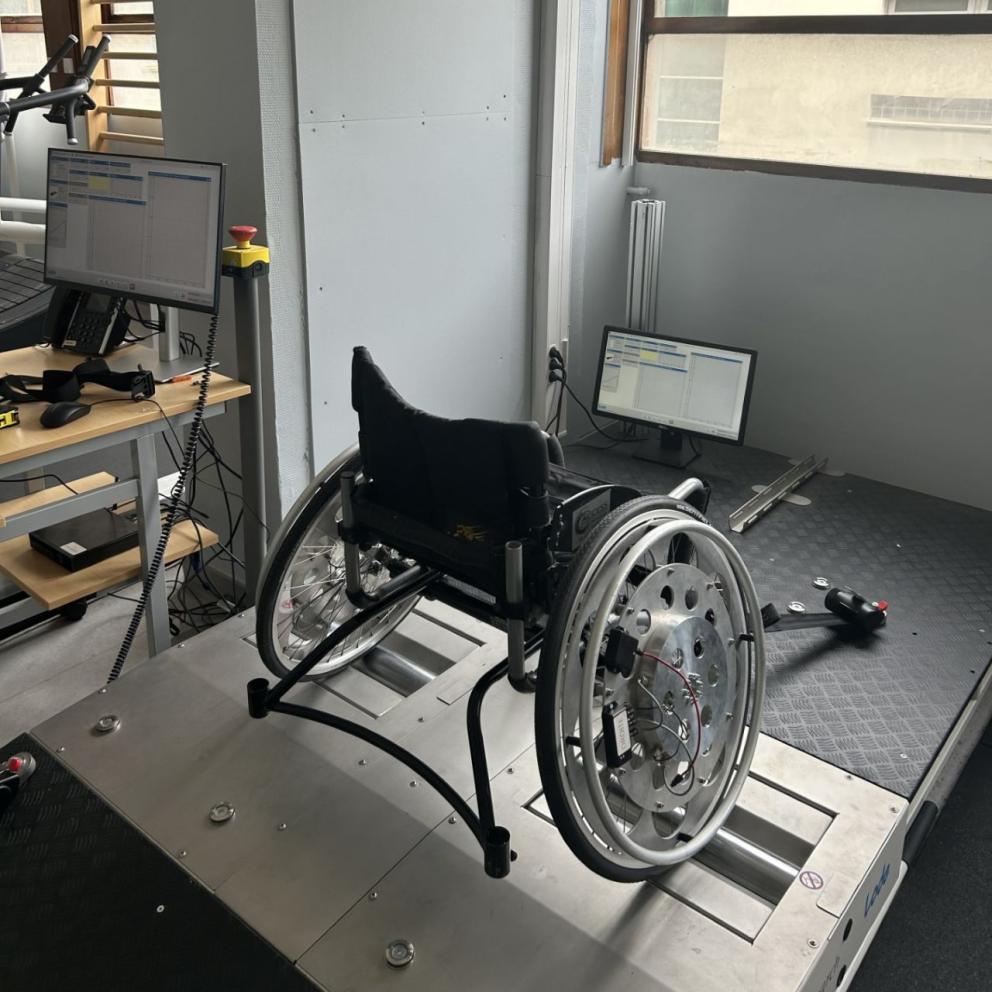
The aim of this project is to accurately measure the power exerted by a person on the wheels of a wheelchair during an activity. To achieve this, HIPE HUMAN LAB is collaborating with Magtrol, which supplies the various sensors needed to collect the data. The research unit is responsible for electronics design, development and programming.
A first prototype has been produced, incorporating an electronic measuring device on each wheel. One wheel is fitted with two optical speed sensors to measure speed and direction of rotation via a code wheel attached to the wheelchair, and a torque sensor integrated into the wheel axle to measure the forces exerted on the wheelchair's handrail. Once the data has been collected via Bluetooth using a specially designed smartphone application, the experts combine the speed and force measurements to obtain the power exerted by the wheelchair user. Laboratory tests have confirmed the prototype's reliability by comparing the information collected with that of a wheelchair ergometer.
Towards an improved, autonomous prototype
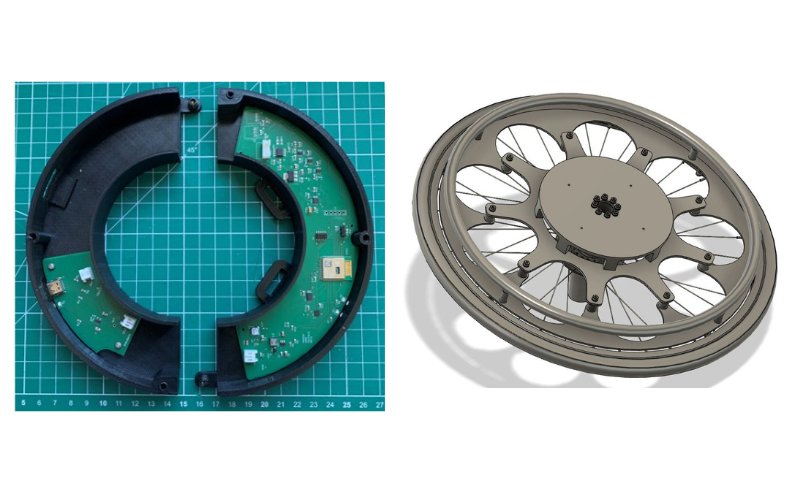
Although accurate, the first version of the connected wheels shows its limits at low speeds and remains complex for use outside the laboratory. That's why experts are currently working on a second prototype. This should improve power measurements and make the wheels fully autonomous, with sensors and electronics integrated inside the wheels. A gyroscope will also be added to improve speed measurement.
Once this prototype has been validated, a number of research fields will open up, both for top-level athletes and for non-athlete users. However, each project will require specific adaptations, particularly for disabled sports where the wheels of the wheelchairs may vary depending on the activity.
Ultimately, the aim is to make this tool accessible to coaches and athletes so that they can use it autonomously to optimize their training. Thanks to precise measurements and real-time data, they will be able to adapt their physical preparation to reach the top.
Beyond the sporting arena, this tool could also be used by other structures, for example to measure the power required by a disabled person to move around town, in comparison with an able-bodied person. This would open up new avenues of research and improve accessibility and mobility for wheelchair users. The potential applications are vast, and promise to transform not only the world of disabled sport, but also the daily lives of people with reduced mobility.