

Thursday, May 30, 2024
On the eve of the 2024 Olympic Games, optimizing the performance of our athletes is at the heart of all discussions. And as we know so well by now, science and technology are real allies in preparing our top athletes for national, and international, competitions.
The ballistic ergometer is also part of this line.
Patented by Aix-Marseille University (machine inventor Arnaud Hays and André Jacques, application developer Justin Regnaud), the ballistic ergometer or force-velocity machine is used in particular in the work of doctoral student Samuel Trama within the HIPE Human Lab research support unit.
What is a ballistic ergometer?
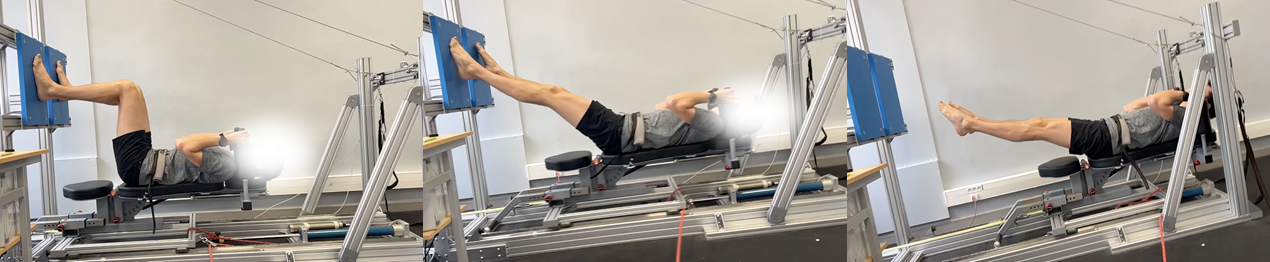
Similar in appearance to a weight room press, the ballistic ergometer's configuration enables real horizontal jumps to be performed, while measuring the force, speed and power produced.
In the literature, the study and implementation of tests in this horizontal position are uncommon. Yet this orientation offers significant advantages. It allows the athlete to be free from body mass, while minimizing ground impact.
Although the focus here is on the lower limbs, the machine can also be used to analyze the upper limbs, with push and pull movements.
This technology promises advances in sports performance assessment, as well as in post-injury recovery.
Performance
To optimize performance, the research support unit offers a battery of customized tests, such as jump and sprint tests, force-velocity profiles on the ballistic ergometer and V02 max.
These tests are adapted to the athlete's discipline, position and physiological specificities.
In this context, the ballistic ergometer is used to collect data on an athlete's ability to produce force in a very short space of time, which is particularly useful for sports requiring high explosive power, such as team sports or sprinting.
All these tests complement each other, enabling the experts at the HIPE Human Lab research support unit to provide invaluable feedback to coaches and physical trainers on how to optimize their athletes' training.
Post-injury recovery
The
ballistic ergometer could also be a valuable ally in the post-injury rehabilitation process.
With the aim of scientifically validating the value of the ballistic ergometer on a medical level, Samuel Trama's thesis has received funding from the Sud region. A clinical study will be launched at the end of 2024, in collaboration with several researchers, doctors and surgeons from Marseille and Aix-en-Provence.
With the help of this technology, experts could be able to assess the physical capabilities of injured sportsmen and women, and determine their ability to resume sporting activity, while minimizing the risk of recurrence.
In addition to physical capabilities, other elements will be studied and taken into account, such as limb asymmetries, which can prove very useful for this type of study. In fact, usually only one of the two limbs is injured, allowing comparison between the injured and uninjured limbs. Researchers will also be looking at patient metadata (age, sport, level of sport) to better understand and interpret the data collected.
Working closely with mathematicians (LIS, CEDRE project), the research team will develop statistical and artificial intelligence models based on the data and metadata collected. The researchers are very hopeful that these models will eventually make it possible to assess and classify the risk of recurrence after injury, as well as to better personalize a patient's rehabilitation.
In conclusion, the ballistic ergometer is establishing itself as a key tool for optimizing performance, by offering precise, personalized assessments, thus boosting the chances of success in national and international competitions. The ballistic ergometer also offers great hope for the rehabilitation of athletes.