

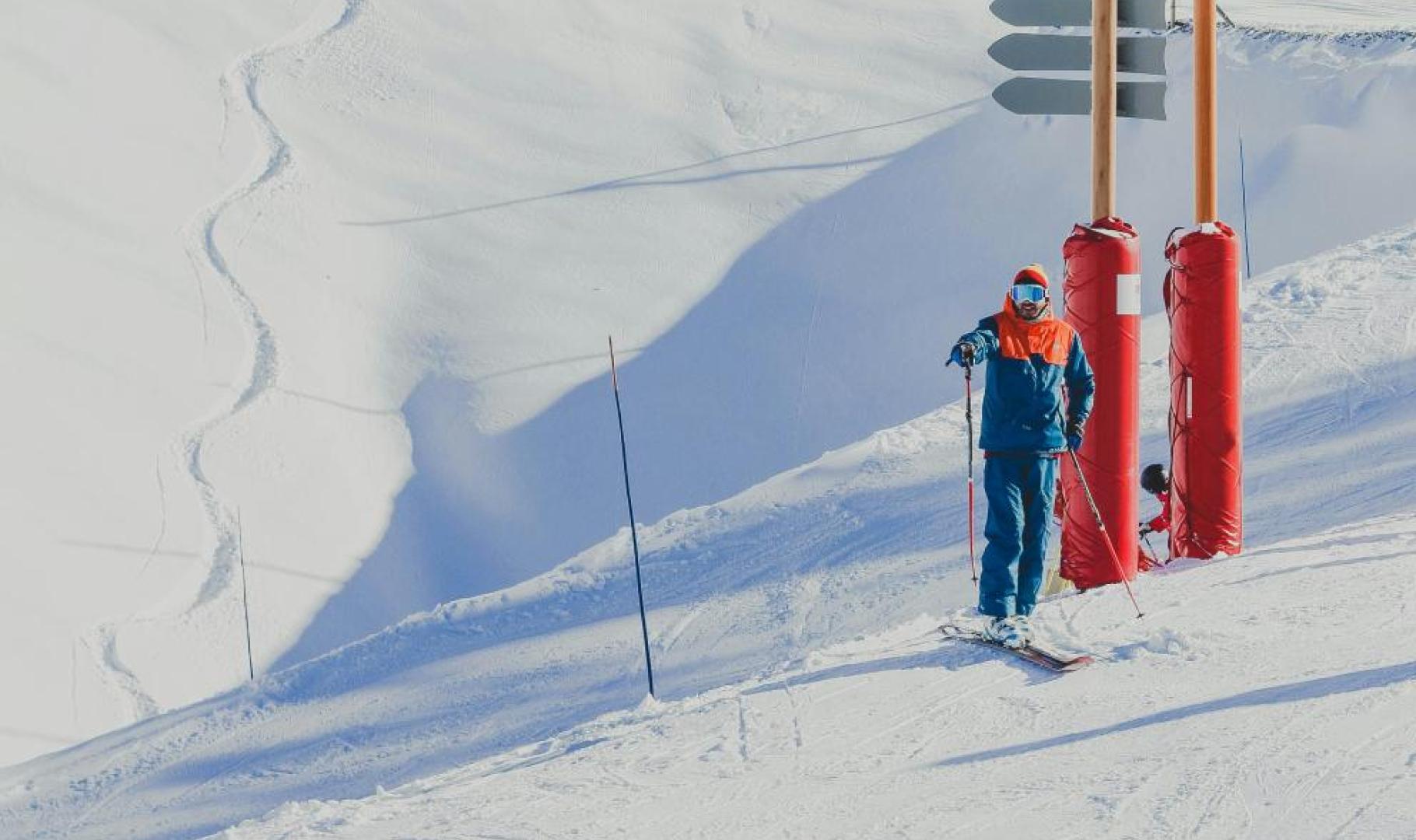
Whether you're a Piou Piou team member or the king of the slopes freshly decorated with your Gold Star, you've certainly already come across these protective mats on your ski runs, often orange in color, which hug fir trees, pylons and artificial obstacles of all kinds, in order to make the slopes safer.
In this new collab', light is shed on Marine Dorsemaine's research into the safety issues surrounding protective mats (and their installation) in ski resorts. Marine is a doctoral student at Aix-Marseille University and has been carrying out her thesis since 2018 at the Laboratoire de Biomécanique Appliquée - LBA (Aix-Marseille University / Gustave Eiffel) in collaboration with Domaines Skiables de France.
The genesis of the project
On ski slopes, numerous mattresses are currently installed on various obstacles to reduce the severity of injuries in the event of a collision. This equipment is subject to a manufacturing standard (AFNOR NF S52-105, 2003) which defines the characteristics of mattresses in terms of absorption capacity, waterproofing and envelope resistance. However, it appeared that mattress performance and the representativeness of this standard were insufficiently documented. This led to the definition of the subject of Marine's CIFRE thesis.
The scientific problemThis
research project aims to assess the performance of mattresses in protecting against injury, in relation to accident conditions and real-life use, with a view to improving them. In other words, the aim is to understand how mattresses behave, under what conditions they reach their performance limits or lose effectiveness, and which parameters affect (or not) their behavior/performance, in order to propose improvements.
The scientific approach
Characterizing traumatology following collisions with obstacles
It was clear that little information was available on collisions. An epidemiological analysis was carried out in collaboration with the Association des Médecins de Montagne and the Système National d'Observation de la Sécurité en Montagne (SNOSM). The data collected enabled us to gain a better understanding of collisions against obstacles, and to characterize the victims of these accidents, the injuries sustained, and the risk factors involved.
Characterize impact conditions in a wide range of obstacle collision scenarios
We then carried out 910 numerical simulations reproducing collisions with unprotected obstacles, in order to identify the body zones impacted by the obstacle in different accident scenarios, with varying initial speeds. These models must be as representative as possible of runway accidents, in order to determine the conditions under which the mattresses are subjected to stress. These simulations highlighted the importance of protecting the head and torso, areas of the body frequently impacted at high speeds during collisions.
Assessing mattress performance in real-life conditions
The results of the numerical simulations were used to define the conditions for experimental tests on mattresses in ski resorts. Over 670 impacts of a metal head or resin torso were carried out on 75 mattresses. These tests demonstrated the influence of impact speed, mattress thickness and air content on damping capacity.
Evaluating the performance of protective mattresses in a variety of accidents
The analysis of mattress performance was continued by evaluating the risk of head and thorax injuries in numerical simulations of collisions with obstacles. The obstacles were protected by mattresses of different thicknesses. The 3692 simulations carried out highlighted their performance in terms of protection against serious injury, but also their limitations in the event of impact at high speed.
Project results and prospects
Thanks to this work, recommendations for the revision of the current mattress manufacturing standard have been drawn up, along with proposals for the creation of a standard for the use and management of mattresses throughout their life cycle. A prototype self-evaluation bench has also been developed, which should eventually enable ski resorts to estimate mattress performance over time, independently and without any particular scientific knowledge.
We have received very positive feedback from Domaines Skiables de France. The work carried out so far has enabled us to gain a better understanding of collisions with obstacles, and provides data for the implementation of specific prevention campaigns, for the sizing of rescue services and for slope development.
These results will also be used to develop standards (for manufacture and use), and to design and evaluate the mattresses of today and tomorrow. "
Marine Dorsemaine
Published article (JCR indexed journal, impact factor of 4.32 in 2020). Dorsemaine, M., Bailly, N., Riveill, S., Faucheur, T., Perretier, C., Masson, C., & Arnoux, P.-J. (2021). About some factors influencing safety mattress performances in head impact collisions: A pilot study. Journal of Science and Medicine in Sport, 24(10), 1067-1072. https://doi.org/10.1016/j.jsams.2021.02.015