

Monday, August 26, 2024
Ice baths, or cold baths, have become a popular method of recovery for top-level athletes.
In contact sports such as rugby or boxing, cold baths help to reduce inflammatory responses. Formula 1 drivers also incorporate this technique after each session to rapidly lower their core temperature, and recover more quickly. For endurance sports such as cross-country skiing and mountain biking, cold baths are used in particular to improve blood circulation.
Although they are all aimed at optimal recovery, the benefits expected through the integration of this technique differ according to the activity. To maximize the effectiveness of these cold baths, it's crucial to determine which protocols would be best suited to meet these multiple needs.
This is precisely what Dorian, a doctoral student at the UAR HIPE HUMAN LAB, is working on in collaboration with the Centre de Résonance Magnétique Biologique et Médicale (CRMBM), the Centre de Résonance Magnétique des Systèmes Biologiques UMR5536 / CRMSB (a joint research unit attached to the CNRS and the University of Bordeaux), and the Institut Universitaire des Systèmes Thermiques Industriels (IUSTI).
Towards an optimal cold application method
The main aim of this study is to create and validate a customizable dynamic model that takes thermoregulatory responses into account, so as to accurately predict temperature changes at any point in the area under study (the thigh, initially), as a function of environmental constraints and individual characteristics.
Ultimately, extending this model to the whole body would enable us to predict the best method of applying cold to these patients, depending on their morphology, and thus increase their life expectancy.
From thermoregulation to modelling
To achieve this objective, several experiments are carried out.
The sportsmen and women taking part in the study must be capable of performing intense efforts, such as 50 minutes of cycling, to allow a sufficient rise in temperature.
Before the effort, multiple anthropometric measurements are carried out on the participant. Once the effort has been made, the participants are immersed in cold baths, and their physiological responses are collected. These data are then used to create a finite element model of their legs, taking into account the increase in energy expenditure due to cold (the latter being deleterious for recovery) with the increase in shivering and non-shivering thermogenesis.
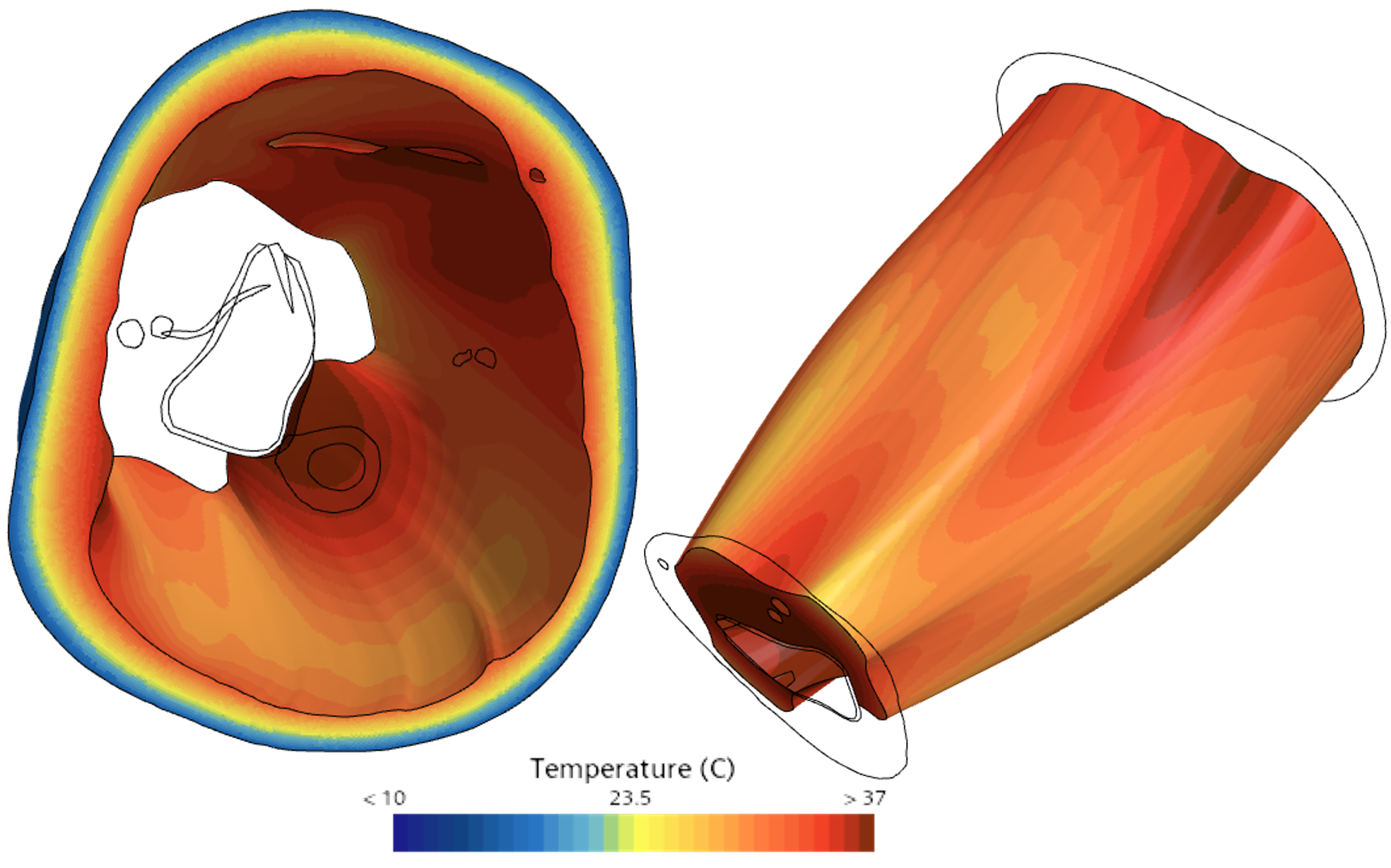
Using Magnetic Resonance Imaging (MRI), anatomical images of the thigh are taken, enabling us to simulate in 3D the application of cold to the outside of this part of the body, and to observe how it penetrates the muscles. MRI is also used to measure muscle temperatures at various points, in order to determine the extent of warming achieved by the different types of thermogenesis, and to validate the concordance between measured and simulated temperatures.
Complementing MRI, techniques such as Doppler ultrasound to analyze vasoconstriction, or near infrared (NIRS) or NMR techniques to measure oxygen consumption locally, reflect energy expenditure.
Thus, recovery protocols can be customized for each athlete, taking into account factors such as gender, build, and thigh circumference, itself influenced by the total thickness of the various tissues that make it up. The study also focuses on specific parameters such as immersion time, water temperature and post-immersion inactivity time. These play a decisive role in cold recovery.
The experts are particularly interested in the post-immersion phase, studying the effects of passive recovery after the cold bath (the athlete remains in a lying position without performing any activity), and those of active recovery (the athlete performs a light effort such as walking).
Customized immersion protocols
The next step in this research is to conduct experiments at higher temperatures, to minimize shock to the organism and obtain new results. Once the model has been established, it will be possible to accurately recommend the ideal temperature and immersion protocols for optimal recovery.
Ultimately, this model could be used to improve not only sporting performance, but also the management of heat stroke and hyperthermic conditions.
Cold baths represent a major, low-cost advance in sports recovery. Thanks to in-depth research and personalized models, it will be possible to optimize these protocols for each athlete, improving their performance and well-being.
These studies will also pave the way for new methods of treating hyperthermic patients, potentially increasing their life expectancy. Metabolic diseases may also be an interesting target for cold water immersion treatment. The science of sport and health is thus progressing hand in hand, promising beneficial innovations for all.