

Monday, January 24, 2022
Focus on her work on the influence of gender on runners' recovery after a 20 km uphill endurance raceIn
this article, she looks back at her research into the influence of gender on runners' neuromuscular recovery during the Marseille-Cassis Run. Caroline studies musculo-tendinous function during locomotion, as well as neuro-muscular adjustments to immediate and delayed fatigue (during muscle soreness), engendered by running.
Caroline Nicol
Maître de Conférences Aix-Marseille Université à l’Institut des Sciences du Mouvement (ISM)
Caroline, how and why did this research project come about?
In 2019, to mark the 80th anniversary of the CNRS and the 40th anniversary of the Marseille-Cassis Race, I was asked - among others - by Patrick Sainton, (now a CNRS research engineer at the ISM and one of my former students) to use this new edition of the Race as a field for research...
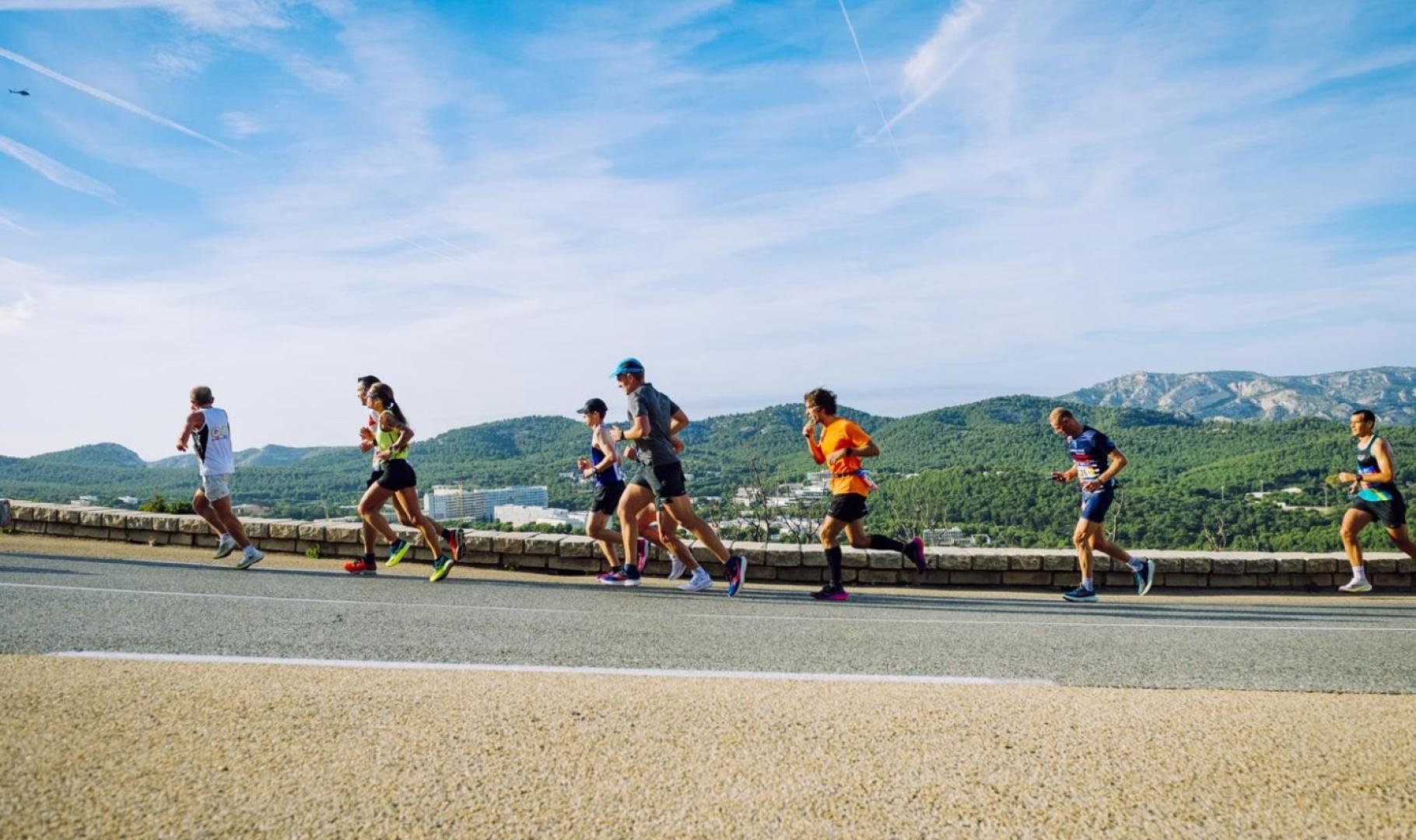
The Marseille-Cassis Race attracts almost 20,000 runners, 33% of whom are women (2019 figures)! It's also, and above all, a 20 km race with a positive and negative gradient of 300 m, which adds up to significant fatigue both immediately after the race and in the days following it.
I've been interested in this inflammatory phenomenon and its consequences on muscle activation for several years now. I've been interested for several years in this inflammatory phenomenon and its consequences on muscular activation, which is associated with inhibitions in the muscles to allow them to recover; inhibitions which begin before the aches and pains are felt, but continue after they have disappeared. During this delayed phase of muscular recovery, performance declines, and people are well aware of this in terms of the muscle soreness they feel. Then comes the risk of injury, when the aches and pains disappear while the initial levels of strength, speed and power have not yet been recovered.
In 2019, 99% of existing literature focused on functional recovery in men. Only 6 papers had been published on functional recovery in women, mostly research that did not take into account the delayed phase of muscle recovery. We therefore decided to study the influence of gender on the kinetics of functional recovery in amateur runners, after a 20 km race with gradients.
Buoyed by the incredible collective momentum around this race, we were awarded a PhD grant from the CNRS "GDR Sport & activité physique", with the recruitment of Robin Macchi, PhD student for 3 years on the project and co-supervised by Fabrice Vercruyssen (IAPS, University of Toulon), and the recruitment of Yoko Kunimasa, post-doctoral student for 16 months and specialist in muscle ultrasound evaluation, thanks to financial support from the Institut Carnot STAR.
What did the study involve, and how did you go about it?
We wanted to study gender-related differences in fatigue and recovery in recreational runners following the Marseille-Cassis Race, in order to better understand and guide these people in their recovery.
In 2019, 18 recreational runners, including 10 women and 8 men with similar running performances took part in the first study. The testing protocol consisted of 5 sessions: one week before the race (baseline); just after the race (150 m after the finish of Marseille-Cassis); a test at +2 h; then 2 and 4 days later (D+2 and D+4).
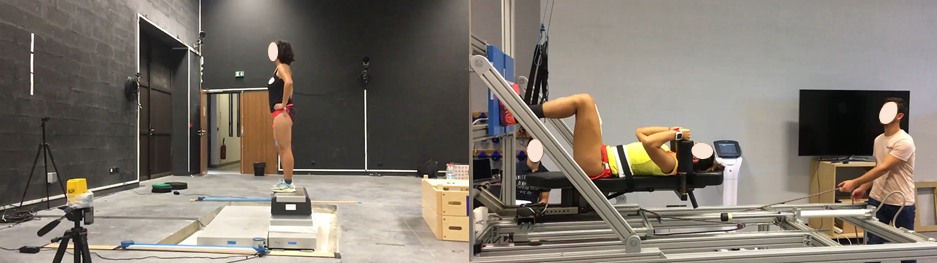
Almost all the tests took place at TechnoSport (AMU platform), a platform with human and technological resources for the study of sports performance. Each session included maximal isometric (static) voluntary contractions of the knee extensors, a squat jump and a drop jump. Delayed muscle soreness was assessed for thigh (quadriceps and hamstrings) and calf (sural triceps) muscle groups. Sessions D+2 and D+4 also included a horizontal strength-velocity test (using an ergometer developed on the platform as illustrated in the images below), during which the electromyographic activity of 8 muscles of the lower limb was recorded. For each test, a set of key variables was calculated to characterize functional recovery.
A second study carried out this year analyzed the relationship between monitoring functional and structural recovery, using non-invasive imaging techniques (MRI/ultrasound). These imaging techniques make it possible to assess the extent, location and recovery profile of muscle inflammation. The blood markers usually used do not reflect the quantity, severity or timing of muscle damage. This work was carried out in collaboration with the Centre de Résonance Magnétique, Biologique et Médical (CRMBM).
tests were carried out on a group of 13 men and 14 women registered for the Marseille-Cassis race, of whom 4 men and 4 women took part in the imaging tests. Functional recovery monitoring included recording the activity of 10 lower limb muscles during maximal and submaximal intensity tests, in order to study the influence of gender on activation patterns and intermuscular compensations. The analysis of adjustments in running pattern and muscle activation involved data recorded on a treadmill at submaximal speed during 3 conditions: at normo weight (100% body weight), at lightening (60% body weight) and on return to normo weight.
What results did you obtain?
Initial results from the 2019 race[2] show male/female differences in muscle soreness, less functional loss and earlier recovery for women on certain tests following an endurance event such as the Marseille-Cassis Race. We also found a gender influence on muscle activation patterns, which varied differently during recovery. This year's data should enable us to refine the choice of tests and measures for assessing deficits. Do the lesser functional deficits in women stem from a less damaged muscle structure? Faster muscle regeneration? We already know that women's estrogens are likely to contribute to both, but as the recent review to which we have just contributed points out, everything remains to be done in this field.
This year, the central question will be to try and verify (again by imaging), following this type of race, the reality of the extent and time course of muscle micro-lesions and their functional consequences. In any case, and irrespective of gender, functional deficits persist even though muscle soreness has disappeared, and it should be stressed that this post-stiffness phase puts joints at risk, as they remain less well supported due to muscular inhibition.
On the scientific front and in terms of communication, 2 articles including a review on the differences between men and women in endurance running have been published[2]. In addition, an article on muscular synergies has been submitted, and we have also participated in three international conferences on the subject. In the future, we'd like to offer runners advice via a mobile application, because in terms of sport and health, there are strong gender-specific messages to be conveyed. There are also socio-economic spin-offs, thanks to the links forged with sports federations (athletics, team sports), sports clubs/race organizers, sports doctors and physiotherapists, and potential medium-term industrial spin-offs for, for example, manufacturers of portable ultrasound equipment or application developers.
On a more personal note, this project is a wonderful synergy of structures. I'm enjoying it, and I'm lucky enough to be in the middle of it all! It's a project that has benefited from the incredible dynamism of men and women, not to mention the very important partnership with SCO Ste Marguerite, organizer of the Marseille Cassis race and offering expert advice on its site and at the Village Expo.
Any advice for those who want to start running?
In these times when we're more than a little sedentary, my 1st recommendation is: get out there, get moving! If you're starting out by running, the important message to keep in mind to avoid injury is that soreness is a good thing, playing the role of a "warning" sent by our body, but which disappears too soon. The body needs time to recover, so you need to be vigilant on the day the soreness disappears, respecting the notion of progressiveness in effort and the recovery time needed to regain full capacity and avoid the risk of injury as much as possible. When you start running, in the days following exercise, be careful with stretching, deep massages and anti-inflammatories, which will temporarily mask the pain, giving you the feeling that you've recovered more quickly. Then, gradually, start exercising again, because the more you do, the less it will hurt!
[
1] International Women's Sports Day
The aim of this day, celebrated on January 24, is to promote women's participation in sport and to anchor women's sport in everyday practice, focusing on 4 main areas: the development of women's participation in sport; the presence of women in sports governing bodies; the economics of women's sport; media coverage of women's sport.
This operation is supported by the Ministry of Sports, the Secretary of State for Equality between Women and Men, the French National Olympic and Sports Committee, the Paralympic Committee and the Femix Sports association.
[2] PublicationsMacchi
- R, Vercruyssen F, Hays A, Aubert G, Exubis G, Chavet P, Goubert E, Souron R, Kunimasa Y, Nicol C (2021) Sex influence on the functional recovery pattern after a graded running race: original analysis to identify the recovery profiles. Front.
- Physiol.
- Besson T, Macchi R, Rossi J, Morio C, Kunimasa Y, Nicol C, Vercruyssen F, Millet G (in press) Sex differences in endurance running.
- Sports Medicine.
- Macchi R., Santuz A., Hays A., Vercruyssen F., Arampatzis A., Bar-Hen A., Nicol C. (submitted) Sex influence on muscle synergies in a ballistic force-velocity test during the delayed recovery phase after a 20 km graded endurance run