

In a sport where performance is measured in hundredths of a second, the contribution of data is an obvious complement to human vision and intuition. The French Swimming Federation has understood this, and the collection of physiological, technical and biomechanical data has become a matter of course for Robin Pla, its National Technical Advisor (CTN). And to push back the limits of performance, with the 2024 Olympics in its sights, French swimming is relying on the Fast_Spor'In network and Aix-Marseille University's TechnoSport to develop new measurement tools...
A technology platform accredited by Aix-Marseille, attached to the Institute of Movement Sciences and a member of the Carnot STAR Institute, TechnoSport is a unique place dedicated to innovation in sport and movement. Its collaboration with the French Swimming Federation revolves around three performance measurement technologies. These tools are being tested at the Cercle des Nageurs de Marseille (CNM), an emblematic local club and a benchmark for French swimming excellence.
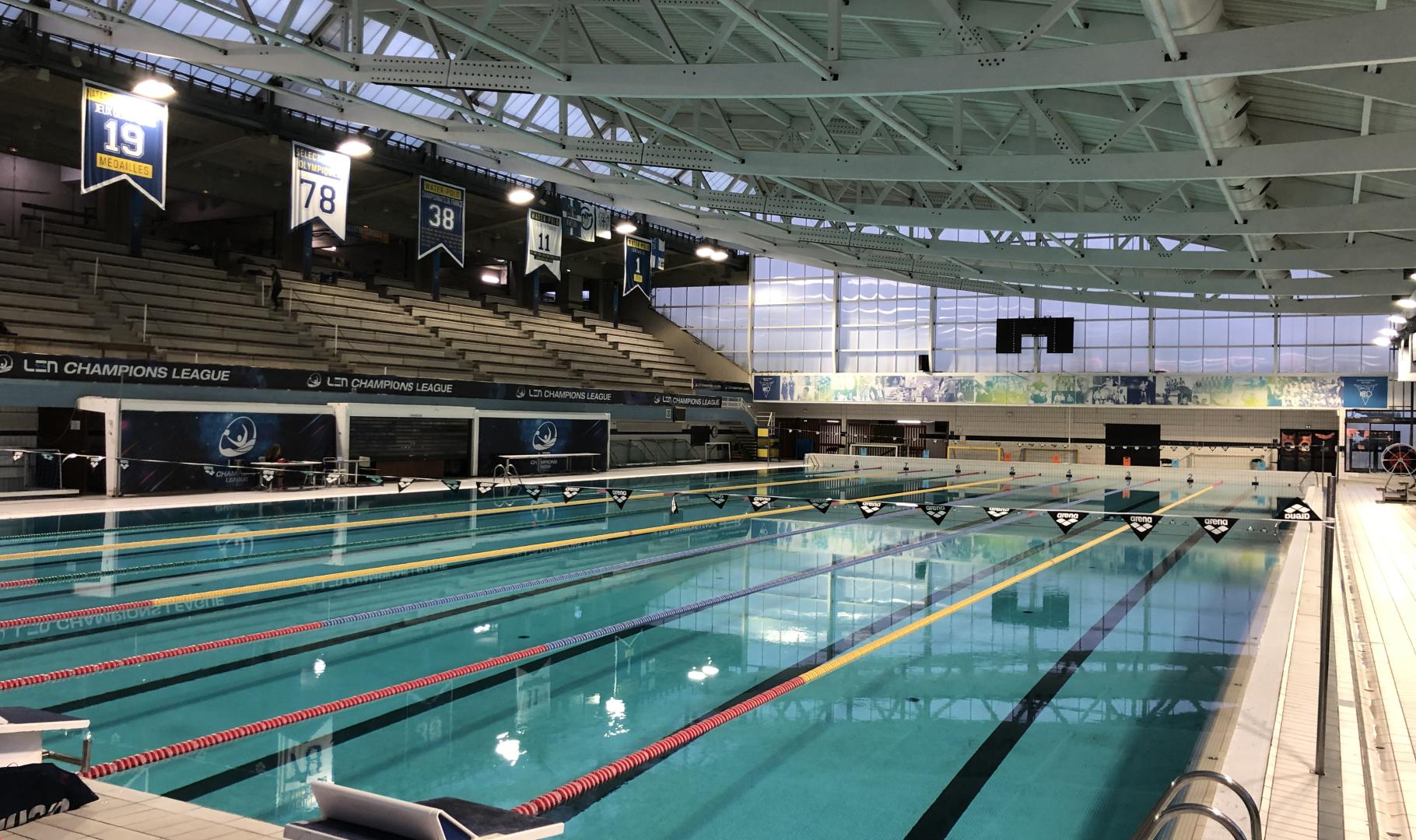
Le Cercle des Nageurs de Marseille: a lab of choice
" Initially, we worked with the CNM via the ballistic ergometer we had developed to analyze athlete performance, in particular to determine their neuro-muscular quality. We were then able to obtain their force/velocity profile in the air. We then very quickly asked ourselves what qualities they would need in the water. Working with the CNM was an obvious choice, given the club's geographical proximity and size.
A force platform to study the dominant force/speed profile
The research project was then launched to study the dominant force/speed profile in the water, in particular in bends, a compulsory and regulated technique in competition.
"A force platform already existed, but with its high cost and lack of convenience, it didn't correspond to what we were looking for.
Arnaud Hays
After several adjustments, the platform, financed by Filière Fast_Spor'In, was installed in the CNM pool for testing. Lightweight, easy to handle and simple to use, it quickly aroused the interest of coaches, who benefit from real-time data feedback via a mobile application. "The advantage of our team lies in its multidisciplinarity. We have a developer who has enabled us to have a smartphone application to collect live data" Arnaud Hays.
A feature that seems obvious in our ultra-connected world, but is not so in swimming.
" Most movements take place underwater, which makes things difficult to measure. Data is much more difficult to obtain than in other sports, and even more so when it comes to getting it live. The turn is not an isolated act.
It will have an impact on the rest of the race.
A timed gate to improve the accuracy of time data
After calculating force, the team set about calculating time. For this, they turned to various laboratories at Aix-Marseille University, in particular LP3, which contributed its expertise in lasers to develop a timed gate in water.
"We've done a proof of concept, and with funding from the Institut Carnot STAR, we're now in a position to move on to a real prototype. The Federation is very interested, because it's something that doesn't exist.
Arnaud HaysFor
Robin Pla, this data not only confirms and objectifies swimmers' performances, but also makes training more dynamic: "There's a playful side to it that invites athletes to challenge themselves. It's interesting in terms of learning.
An instrumented swim line to measure heart rate in water
As is often the case in swimming, it is impossible to use measurement tools instantaneously, due to the lack of Bluetooth connectivity in water. Live heart rate measurement is therefore also impossible at present. To overcome this, teams at Aix Marseille University are developing a solution that would enable heart rate to be tracked by instrumenting a water line . "The idea would be to place terminals around the lines, with an antenna linking the water to the air and enabling data to be retrieved in real time," explains Robin Pla. The project is being carried out in collaboration with Institut Fresnel, a Carnot STAR laboratory with expertise in radio-frequency antennas. " This ability to source expertise from different laboratories is much appreciated by the French Ministry of Sports," emphasizes Arnaud Hays.
"What's interesting about working at the University is the opportunity to bring together several laboratories to work on common projects".
Three projects that complement each other, and are a source of great satisfaction to executives at the Fédération Française de Natation. "It's a huge advantage to have scientific experts able to understand the needs of the field, while at the same time providing tailor-made hardware solutions. These three tools are ultra-specific to the activity, and they don't exist anywhere else". A laboratory/federation collaboration that benefits French sport and predicts an Olympic Games under the sign of technology.
*The Filière Fast_Spor'in, made up of three Carnot Institutes (STAR, MICA and LETI), is a public PIA program dedicated to business innovation in the field of Sport and Wellness. Started in 2015, the Filière's actions end this year (2022).