

Will tomorrow's vehicle be flying, autonomous or 5-star? This is the question being addressed by the Automotive Motion Lab, the first joint laboratory - or Open Lab - initially created by Stellantis and the Institut des Sciences du Mouvement (ISM). What makes it special is its human-centered approach: while thinking about means of locomotion has long been mechanical and technical, Automotive Motion Lab researchers are interested in people, whether drivers or passengers, and how they interact with the vehicle.
OpenLab: a win-win deal
OpenLabs are collaborative research structures made up of an industrial group, universities and research units.
The Automotive Motion Lab was born in 2011, out of the desire of a world leader in the automotive industry, Stellantis (formerly PSA), to get closer to Research, so as to always be as close as possible to innovation. The aim of this laboratory, based on the Aix-Marseille University campus, is to harness knowledge in motion and cognitive sciences to imagine the vehicles of tomorrow and their design methods.
Three laboratories now involved
To broaden the Automotive Motion Lab's spectrum of expertise and skills, two laboratories in Marseille have joined the structure:
- Institut Fresnel, with its "Light and Vehicle" research program;
- PRISM, with its expertise in sound
In all, 48 people are currently involved in the Automotive Motion Lab.
"Relying on university laboratories offers a wide range of perspectives in terms of time scales and the level of depth of a question. For us, it often starts with a difficulty or a problem.
A problem that becomes a scientific question and, as Jean-Louis Vercher points out, "enables laboratories to look into themes they wouldn't necessarily have thought of".
Clément Bougard
Putting people at the heart of the design process
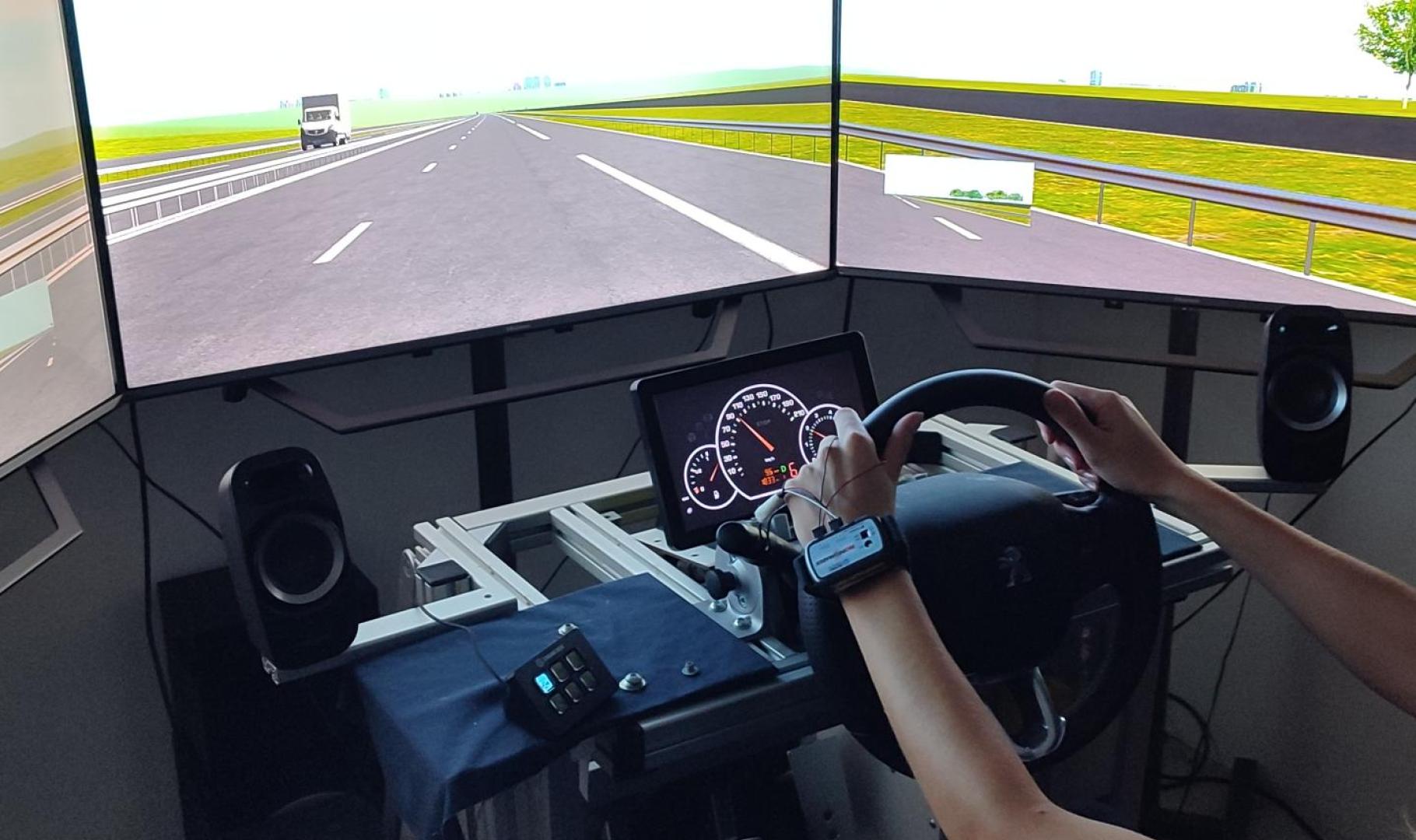
The Automotive Motion Lab is unique in its focus on human interaction. It studies human-vehicle interactions to optimize and improve the realism of driving simulators, and contributes to the development of new driver assistance systems.
"Back in the day, a carmaker focused mainly on engineering, mechanics, engines, suspension, fuel consumption and so on.
Then the human factor became increasingly important, because the vehicle is also an object of comfort, a privileged place, a place where we spend a lot of time. "
Clément Bougard
Research topics range from vehicle perception (interior/exterior) to driver state (attention and alertness), seat comfort and multimodal interactions. Motion sickness, in particular, is the subject of a thesis. " This is a particularly interesting issue at the moment," explains Clément Bougard, "because the question of autonomous vehicles is leading us to rethink the state of the driver who, when he becomes a passenger in his own car, can potentially develop symptoms (feeling sick, nausea, etc.). The question is therefore how to manage the transition phase when he or she has to take back control of driving."
What's next?
The Automotive Motion Lab project has been renewed twice since its inception; once in 2016 and the last time in 2021 for a period of four years. These studies give rise to articles and patents, which will result in technologies that are more robust, more innovative and safer than current technologies, which are often single-sensor technologies, whereas the plurality of the Automotive Motion Lab's expertise enables us to move towards multi-sensor technologies, with integrated AI.
"
This mutual enrichment enables Stellantis to remain at the cutting edge of technology, and the laboratories to carry out in-depth research on innovative topics.