

Friday, April 26, 2024
With the 2024 Olympic Games fast approaching, challenges and opportunities in the field of sports research are intensifying.
At the heart of this effervescence, Erwan Beurienne, a PhD student at the Laboratoire de Biomécanique Appliquée (Université Aix-Marseille, Université Gustave Eiffel), stands out for his commitment to pushing back the boundaries of safety in a fast-growing discipline: bouldering.
Part of the Olympic program, bouldering involves climbing 4.5-metre-high structures, with landing mats as the only protection.
As the sport grows, so does the number of injuries. A study by Martis Turlan (2023) showed that the most serious injuries in bouldering are due to falls, and mainly affect the lower limbs. Improving fall techniques and ground protection equipment therefore play a crucial role in preventing the risk of injury. This is what motivated our LBA researchers to look into this subject.
The aim of Erwan's work is to propose a method for evaluating protective mats for indoor climbing. To this end, Erwan has adopted a multi-disciplinary methodology calling on a range of tools to achieve his objectives:
- Study of accidentology and impact conditions during a fall in bouldering;
- Numerical reproduction of the most serious accidents and determination of injury criteria;
- Development of a mattress evaluation method based on the results obtained previously.
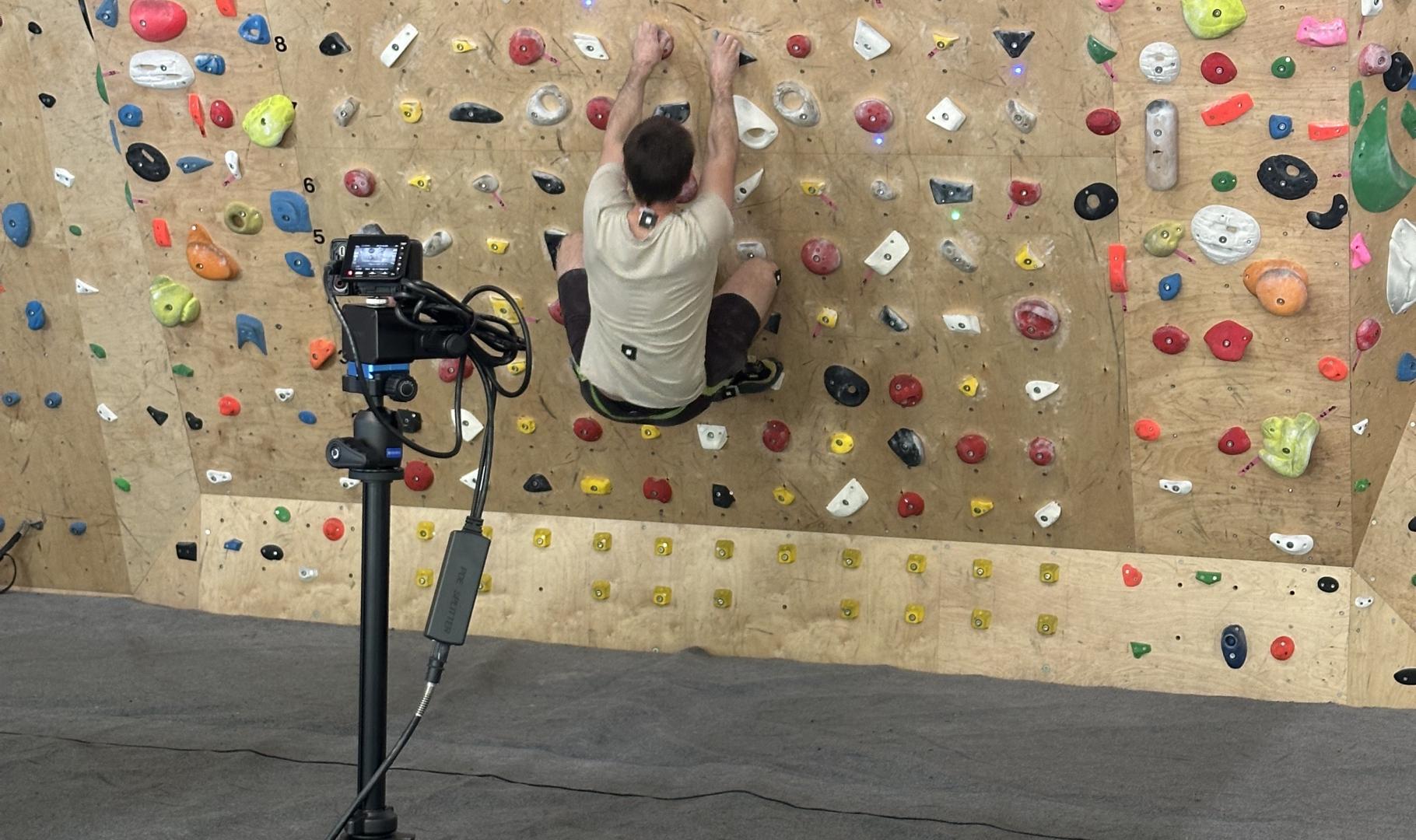
Accidentology and impact conditions in boulderingTo
study accidentology and impact conditions, Erwan focuses on several parameters:
- Climber profiles (age, experience, gender, etc.) :
- Fall kinematics (angle, position, impact speed) ;
- Resulting injuries.
All this information, gathered via questionnaires and video analysis, enables him to better understand typical fall scenarios, which are crucial to the realization of the numerical simulation.
Mattress characterization and numerical simulation
Although these data are essential, they are not sufficient to numerically reproduce a fall on a climbing mattress. It is also necessary to look at and test the various foams incorporated in protective mattresses.
Indeed, these foams are the most important component, since they directly influence the effectiveness of cushioning in the event of a fall. There are many different types of protective padding for bouldering. Although they are all standardized to ensure the safety of their users, they are not all made from the same materials. For this reason, the researchers are testing the mattresses, and in particular their effectiveness in absorbing different falls, using numerical simulations of the aforementioned fall kinematics.
These advanced numerical simulations will subsequently enable them to define injury criteria, and propose a mattress evaluation method.
A brighter future for boulderers
This research is a great step forward for the climbing world, as it will help to raise safety standards and prevent the risk of injury. The repercussions of this study will not be limited to top-level climbers, but will have a significant impact on the entire climbing industry. This work on bouldering is just one example of the innovative advances that will shape the future of sport and athlete safety.
By combining scientific expertise and technological innovation, the Applied Biomechanics Laboratory is positioning itself as a major player in the quest for safety and prevention in sport.
Matis Turlan. EPITRAUMA-BLOC. Severity and risk factors of injuries caused by the practice of block in artificial structure: prospective cohort study in Reunion Island. Sciences du Vivant [q-bio]. 2023